.25-06 Remington
The .25-06 Remington had been a wildcat cartridge for half a century before being standardized by Remington in 1969. It is based on the .30-06 Springfield cartridge necked-down (case opening made narrower) to .257 caliber with no other changes. Nominal bullet diameter is 0.257, and bullet weights range from 75 to 120 grains (4.9 to 7.8 g).
| .25-06 Remington | ||||||||||||||||
|---|---|---|---|---|---|---|---|---|---|---|---|---|---|---|---|---|
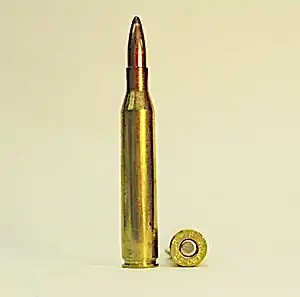 .25-06 Remington cartridge | ||||||||||||||||
| Type | Rifle, Hunting | |||||||||||||||
| Place of origin | US | |||||||||||||||
| Production history | ||||||||||||||||
| Designer | Remington Arms Company | |||||||||||||||
| Designed | 1969 | |||||||||||||||
| Manufacturer | Remington | |||||||||||||||
| Produced | 1969-Present | |||||||||||||||
| Specifications | ||||||||||||||||
| Parent case | .30-06[1] | |||||||||||||||
| Bullet diameter | .257 in (6.5 mm) | |||||||||||||||
| Neck diameter | .290 in (7.4 mm) | |||||||||||||||
| Shoulder diameter | .441 in (11.2 mm) | |||||||||||||||
| Base diameter | .470 in (11.9 mm) | |||||||||||||||
| Rim diameter | .473 in (12.0 mm) | |||||||||||||||
| Rim thickness | .05 in (1.3 mm) | |||||||||||||||
| Case length | 2.494 in (63.3 mm) | |||||||||||||||
| Overall length | 3.250 in (82.6 mm) | |||||||||||||||
| Case capacity | 65.8 gr H2O (4.26 cm3) | |||||||||||||||
| Rifling twist | 1 in 10 in (250 mm) | |||||||||||||||
| Primer type | Large rifle | |||||||||||||||
| Maximum pressure | 63,000 psi (430 MPa) | |||||||||||||||
| Ballistic performance | ||||||||||||||||
| ||||||||||||||||
| Test barrel length: 24" Source(s): Remington Arms [2] | ||||||||||||||||
History
Charles Newton necked down the .30-06 Springfield cartridge in 1912 to accept the 117-grain .25-35 Winchester bullet,[3] but the resulting .256 Newton cartridge didn't get traction. Newton's early modification encouraged commercial release of a shortened case (from 63 to 49mm) as the .250-3000 Savage in 1915.[4] Frankford Arsenal developed an experimental .25-06 during World War I; and distribution of surplus United States military equipment through the Civilian Marksmanship Program following the war encouraged independent gunsmiths to experiment with the cartridge.[3] A. O. Niedner of Dowagiac, Michigan introduced rifles for the .25 Niedner in 1920.[5] Niedner Arms Corporation retained the 17° 30′ .30-06 shoulder chambering .25 caliber barrels rifled with one twist in 12 inches (300 mm).[6] Similar cartridges were identified as the .25 Hi-Power, .25 Whelen (analogous to .35 Whelen), or .25-100-3000 (to indicate the ability to achieve 3000 feet per second with a 100 grain bullet rather than the 87 grain bullet used in the .250-3000 Savage). Greater case capacity offered minimal velocity improvement over the .250-3000 Savage case with contemporary smokeless powders.[7] Availability of DuPont's Improved Military Rifle (IMR) powders encouraged commercial release of the .257 Roberts using the 57mm-long Mauser case in 1934.[8] Release of IMR 4350 in 1940 and availability of surplus 4831 powder salvaged from Oerlikon 20mm cannon cartridges after World War II greatly improved performance of the full-length .25-06 case.[9]
Performance
The cartridge is capable of propelling a 117 grain (7.6 g) bullet at up to 3,200 feet per second (980 m/s) and energy levels up to 2,500 ft⋅lbf (3,400 J). Bullets lighter than 75 grains are available in .257 caliber, but were designed for the smaller .25-20 Winchester and .25-35 Winchester cartridges and are too lightly constructed for the high velocities of the .25-06.
The cartridge has less felt recoil than a .30-06 in a similar weight rifle, due to the lighter weight bullets used. Shooters who are recoil sensitive will find the recoil from the .25-06 bearable, but not pleasant enough to shoot all day long. This cartridge is not quite as powerful as the .257 Weatherby Magnum, usually running 200–300 ft/s (61–91 m/s) slower with a given bullet weight.
Uses
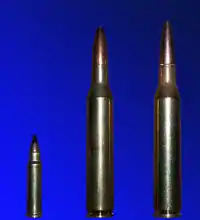
.25-caliber bullets typically have high ballistic coefficients without being heavy. This characteristic, when combined with the large case capacity of its parent .30-06 case, allows relatively high muzzle velocities without heavy recoil. The combination of high ballistic coefficients with high muzzle velocities give the .25-06 a very flat trajectory as well as retaining kinetic energy down-range.
The .25-06 is generally considered to be a good round for medium-sized game such as deer and antelope because of its combination of substantial kinetic energy and moderate recoil. The addition of a flat trajectory makes it particularly popular in plains states where the open fields can require longer-range shots on game, as this flatness tends to minimize range-estimation errors by the hunter. However bullet types and weights are loaded that allow the .25-06 to be used for taking game ranging from small animals like prairie dogs and coyotes to heavier elk. These bullets range from lightly constructed 75-grain bullets with muzzle velocities in the 3,700 ft/s (1,130 m/s) range to more robust 120-grain bullets with muzzle velocities in the 3,000 ft/s (915 m/s) range.
Most manufacturers of bolt action or single-shot rifles offer the .25-06 as a standard chambering and factory loaded ammunition is available from Remington, Winchester, Federal Cartridge and most other major manufacturers.
See also
References
- Hornady Handbook of Cartridge Reloading vol I, Sixth Edition; Book by Hornady Mfg Co., 2003 p. 233
- The Handloader's Manual of Cartridge Conversions, Book by John J. Donnelly, Stoeger Publishing, 1987, ISBN 978-0-88317-269-8 p. 209
- " Archived 2014-10-30 at the Wayback Machine" load data from Remington
- Waite, M.D. & Raynor, Kenneth C. (November 1972). "Loads for the .25-'06 Remington". The American Rifleman.
- Hornady, J.W. Hornady Handbook of Cartridge Reloading Hornady Manufacturing Corporation (1967) p.104
- Hornady, J.W. Hornady Handbook of Cartridge Reloading Hornady Manufacturing Corporation (1967) p.116
- Lyman Ideal Hand Book No. 36 Lyman Gun Sight Corporation (1949) p.138
- Speer, Raymond G. Wildcat Rifle Loads Speer Products Company (1956) p.6
- Hatcher, Julian S. & Barr, Al Handloading National Rifle Association (1951) pp.53-59
- ".25-06 Remington" data from Accurate Powder